
Solana Wallet Basics (Phantom, Solflare, Backpack)
Introduction
Think of a Solana wallet like a digital bank account that you control completely. It is your gateway to the Solana blockchain: you use it to send SOL, trade tokens, collect NFTs, and interact with decentralized apps (dApps).
In this guide, you’ll learn:
- What a wallet actually is (and what it isn’t)
- How to create one safely
- How to use it for everyday transactions
- How to keep your funds as secure as possible
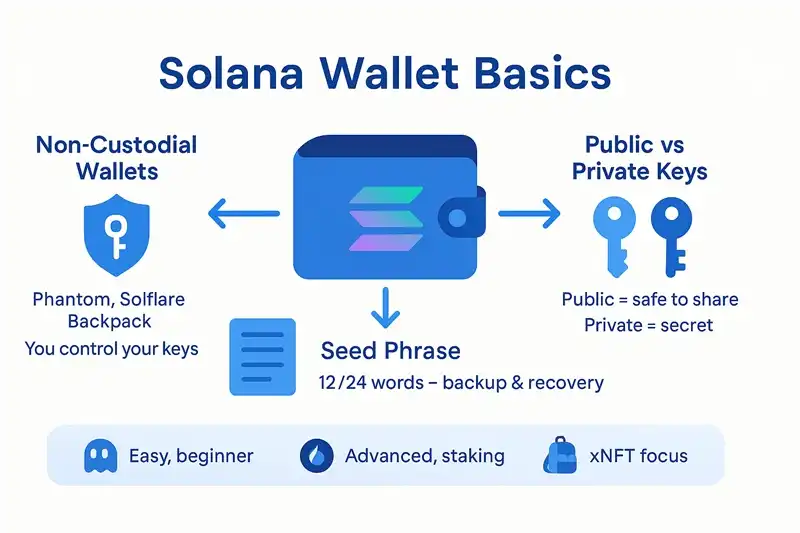
Wallet Basics - Understanding How Solana Wallets Work
What is a Wallet? (Simple Explanation)
A wallet is an app that lets you interact with the Solana blockchain. The key idea:
Your wallet does not store your money.
It stores the keys that let you access your money on the blockchain.
A simple analogy:
- Blockchain = The bank (where your assets actually are)
- Wallet = Your bank card & PIN (how you access the assets)
- Private key = Your PIN (must stay secret)
- Public address = Your account number (safe to share)
Two Types of Wallets
Non-custodial wallets (recommended)
- You control your private keys
- You are fully responsible for backup and security
- Examples: Phantom, Solflare, Backpack
Custodial wallets (exchanges)
- Someone else (exchange) controls your keys
- More convenient but you rely on the custodian’s security
- Examples: Coinbase, Binance
The Three Most Important Things to Know
1. Seed Phrase (Recovery Words)
- What it is: 12 or 24 words that can restore your wallet on any device
- Why it matters: It is the master key to all funds in that wallet
- How to store it: Write it down on paper; keep it offline and in a safe place
- What never to do: Don’t share it, don’t type it into random websites, don’t screenshot it
2. Public Address
- What it is: A long string like
3vWf...that identifies your account - What it’s used for: Receiving tokens and NFTs
- Is it safe to share? Yes, you can share your public address publicly
3. Private Key
- What it is: A secret cryptographic key that proves ownership of your funds
- What it’s used for: Signing transactions
- Is it safe to share? Absolutely not. Anyone with your private key can spend your funds.
Popular Solana Wallets
Here are three widely used Solana wallets:
Phantom (Most Popular)
- Best for: Beginners and everyday use
- Platforms: Browser extension, iOS, Android
- Features: Easy UI, NFT gallery, built-in swaps, staking
- Hardware support: Yes (Ledger)
Solflare
- Best for: Users who want strong staking and more advanced features
- Platforms: Browser extension, iOS, Android, web
- Features: Staking, portfolio view, token management
- Hardware support: Yes (Ledger)
Backpack
- Best for: Users interested in xNFTs and newer Solana-native experiences
- Platforms: Browser extension
- Features: xNFT support, advanced Solana integration
- Hardware support: Yes
Quick Comparison Table
| Feature | Phantom | Solflare | Backpack |
|---|---|---|---|
| Ease of Use | Very Easy | Easy | Medium |
| Beginner Friendly | Yes | Yes | Lower |
| Mobile App | Yes | Yes | No |
| Hardware Support | Yes | Yes | Yes |
| Built-in Swaps | Yes | Yes | Yes |
| Staking | Basic | Advanced | Limited |
| NFT Support | Excellent | Excellent | xNFT focus |
How to Set Up Your Wallet (Step-by-Step)
Step 1: Install the Wallet
- Go to the official site:
phantom.app,solflare.com, orbackpack.app - Choose your browser or mobile platform
- Install the extension or app from the official store
- Pin or place the app where you can easily access it
Step 2: Create Your Wallet
- Open the app/extension
- Click “Create New Wallet”
- Set a strong password (this protects the wallet on that device)
- Your seed phrase (12 or 24 words) will be shown once
Step 3: Secure Your Seed Phrase
- Write it on paper (or metal) by hand
- Create at least two copies stored in different safe locations
- Keep it offline – no photos, no screenshots, no cloud notes
- Verify legibility – make sure it’s readable and correctly ordered
Step 4: Enable Security Features
- Turn on auto-lock in the wallet settings
- Use biometrics (fingerprint/Face ID) on mobile devices
- Choose a short lock timer (1–5 minutes)
How to Use Your Wallet
Receiving Tokens
- Open your wallet
- Click “Receive” and select SOL or a token
- Copy your public address
- Share it with the sender or paste it into the app you’re withdrawing from
- Wait a few seconds for confirmation on Solana
Sending Tokens
- Click “Send” in your wallet
- Paste the recipient’s address (double-check it)
- Enter the amount
- Review the transaction details and fee
- Confirm the transaction in your wallet
Connecting to Apps (dApps)
- Visit the dApp (for example, a DEX or NFT marketplace)
- Click “Connect Wallet”
- Choose Phantom / Solflare / Backpack
- Approve the connection in your wallet
- Use the app; your wallet will prompt you to approve any transaction
Security: How to Keep Your Funds Safe
Core Rules
- Never share your seed phrase or private key
- Only install wallets from official websites or app stores
- Always check the URL before connecting your wallet
- Be suspicious of DMs and “support” messages asking for sensitive data
Common Scams
- Fake support agents asking for your seed phrase
- Phishing sites that look like real wallets or dApps
- Fake browser extensions or mobile apps
- “Free airdrop” links that request a signature giving spending power
Extra Security Tips
- Use a hardware wallet for larger balances
- Keep only smaller amounts in a “hot” wallet for daily use
- Regularly disconnect from dApps you no longer use
- Check transaction details carefully before approving
Troubleshooting Common Issues
I can’t see my tokens
Possible causes:
- Wrong network (e.g., devnet vs mainnet)
- Token account not yet created
- Token is not in the wallet’s default list
What to try:
- Confirm you’re on Solana mainnet
- Refresh your wallet
- Add the token manually using its mint address
Transaction failed
Possible causes:
- Not enough SOL for fees
- Network congestion
- Invalid or incomplete address
What to try:
- Check that you have some SOL (even a small amount)
- Add a priority fee during high usage
- Double-check the recipient address
Wallet won’t connect to a dApp
Possible causes:
- Wallet is locked or closed
- Wrong network selected
- Browser issue or ad-blocker interference
What to try:
- Unlock and reopen your wallet
- Check your network (mainnet vs devnet)
- Refresh the page or try another browser
Hardware Wallets (Extra Security)
What is a Hardware Wallet?
A hardware wallet is a physical device that stores your private keys offline. You confirm transactions by pressing buttons on the device itself.
Popular Options
- Ledger Nano S / X – widely supported, including Solana
- Other devices – check wallet documentation for support
Using Hardware Wallets with Solana
- Connect the device to your computer or phone
- Install the Solana app on the device (for Ledger)
- Open Phantom / Solflare and choose “Connect Hardware Wallet”
- Approve connections and sign transactions on the device
Benefits:
- Private keys never leave the hardware device
- Strong protection even if your computer is compromised
- Ideal for long-term or high-value storage
Privacy Considerations
What’s Public on Solana?
- All transactions
- Account balances
- Token holdings
- NFT collections
Everything is visible on explorers like Solscan or SolanaFM.
Improving Privacy
- Use multiple addresses for different purposes
- Avoid linking your public wallet directly to your real-world identity
- Be careful posting wallet addresses on public social media
- Consider using separate “public” and “private” wallets
📝 Conclusion
Setting up a Solana wallet is your first real step into the ecosystem. If you understand:
- The role of seed phrases, private keys, and public addresses
- How to install and secure a wallet
- How to connect safely to dApps
- Why security hygiene matters more than anything
then you’re already ahead of many users.
Start small, practice sending and receiving small amounts, and only move larger values once you’re fully comfortable with the flow and the security model.
❓ FAQ
Q: What happens if I lose my seed phrase?
A: You lose the ability to restore your wallet if your device is lost or damaged. There is no central recovery service. This is why backing it up correctly and keeping it safe is critical.
Q: Are browser wallets safe?
A: They can be safe if installed from official sources and used with good security practices. However, for larger balances, using a hardware wallet connected to Phantom or Solflare is strongly recommended.
Q: How do I connect a hardware wallet?
A: Connect and unlock your device, install the Solana app on it if needed, then in Phantom or Solflare choose “Connect Hardware Wallet” and follow the prompts. Your private keys stay on the hardware device.
Q: Why can’t I see my token?
A: First check you are on the correct network (usually Solana mainnet). If the token account does not exist yet, your wallet may need to create it. For some tokens, you must add them manually using the mint address.
Q: How much SOL should I keep for fees?
A: Even a small amount (for example, the equivalent of a few dollars) can cover a large number of standard transactions because Solana fees are low. Just avoid taking your SOL balance all the way to zero.
Q: Can I use the same wallet on multiple devices?
A: Yes. Install the wallet app on each device and import the same seed phrase. All devices will show the same addresses and balances. Only do this on devices you trust.
Q: What if my wallet gets hacked?
A: If you suspect compromise, immediately create a new wallet on a clean device and move remaining funds there. Do not reuse the old seed phrase. Review which dApps you connected to and how the compromise happened.
📚 References and Further Reading
- Phantom Wallet – Official Phantom website
- Solflare Wallet – Official Solflare website
🔗 Related Topics
- How Solana Works – Understanding the network
- Transactions & Fees – How fees work and how to manage them
- Creating Tokens – Using DEXArea to create Solana tokens