Solana Token Security Checklist Before Launch
A practical pre-launch checklist for Solana tokens: mint address, supply, authorities, metadata, Devnet tests, liquidity, distribution, and public trust.
Solana Token Security Checklist Before Launch
Launching a Solana token isn't just about minting coins. A token's reputation and safety depend on how well its creators prepare before announcing a launch, providing liquidity or distributing tokens. Small mistakes—wrong decimal settings, incorrect metadata or leaving mint authority active—can undermine holder confidence and make a project look unprofessional. This guide walks you through a complete Solana token security checklist so you can prepare a safe, trustworthy launch and know which DEXArea tools to use along the way.
TL;DR
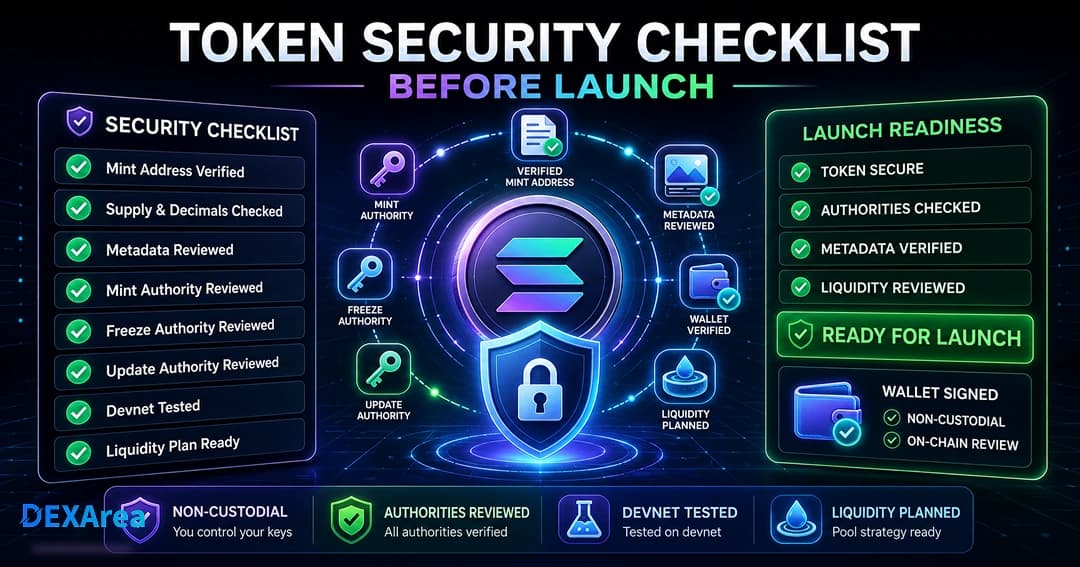
This checklist is long by design—it covers every topic a token creator should consider before going public. If you're short on time, start by verifying your token's mint address, supply and decimals. Check that mint authority and freeze authority are set as intended. Decide if and when to make metadata immutable, review your liquidity plan and distribution strategy, and always test critical workflows on Devnet first. Remember that DEXArea is non-custodial—transactions are signed from your own wallet.
Why Token Security Matters Before Launch
Tokens on Solana are uniquely identified by their mint address, and the mint account stores core information including supply, decimals and the addresses with permission to mint or freeze tokens. These parameters signal to holders whether your token is well-managed or risky. Leaving the wrong authority active can open the door to future supply inflation or account freezes. Incorrect decimals or supply mistakes can make the token confusing to trade, and bad metadata can look unprofessional. A careful pre-launch review reduces these avoidable risks and increases user confidence, but it doesn't guarantee price stability or project success. Security is about trust and operations, not speculation.
1. Verify the Token Mint Address
The mint address is the token's true identity on chain; token symbols and names can be duplicated. Every announcement, pool configuration or multisender list should reference the exact mint address. Save it in internal documentation and double-check the network (Devnet vs Mainnet) before sharing or transacting.
- Mint address copied correctly – Always copy/paste directly from your wallet or explorer and avoid typos.
- Network confirmed – Ensure you're using the correct cluster (Mainnet, Devnet) before interacting with a mint.
- Token symbol and decimals verified – A mint account stores supply and decimal precision, so verify these match your launch plan.
- Mint address documented – Store the address in team docs, websites and white papers so holders can independently verify it.
2. Review Token Supply and Decimals
The initial supply affects your token's economy and distribution plan, while decimals affect how balances are displayed in wallets and explorers. Incorrect decimals (for example, 8 instead of 9) can cause confusion or mispricing. Finalize your supply and decimal decisions before revoking mint authority.
- Final supply reviewed – Make sure the supply aligns with your project's economics and community expectations.
- Decimals reviewed – Decide on decimal places (e.g., 6, 8 or 9). Changing decimals after launch is not trivial.
- Treasury allocation planned – How many tokens will remain in team control? Consider vesting or multi-sig wallets.
- Liquidity allocation planned – Determine how many tokens will be paired with SOL, USDC or other assets.
- Airdrop/community allocation planned – Define amounts reserved for airdrops, staking rewards or grants.
3. Review Mint Authority
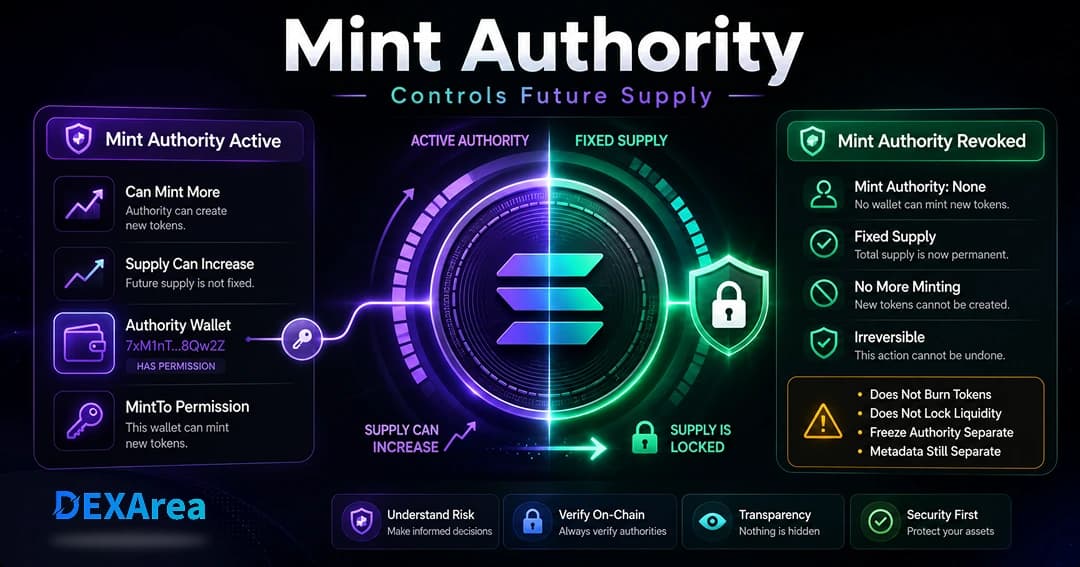
The mint authority is the account allowed to create new units of your token. If it remains active after launch, holders may worry that more tokens could be minted at any time. In many fixed-supply projects, mint authority is revoked once all intended tokens are minted. Revoking is usually permanent—if you need future emissions, you may keep it active or assign it to a trusted multi-sig.
- Current mint authority identified – Know which wallet can mint tokens.
- Final supply minted – Only revoke after minting the total supply.
- Future minting requirements reviewed – Emission schedules may require keeping mint authority longer.
- Revoke decision made – Document your reasoning for holders.
- Revoke transaction saved if completed – Keep signatures for transparency.
Warning: Do not revoke mint authority if your token design requires future emissions, rewards or controlled supply increases.
4. Review Freeze Authority
The freeze authority can freeze token accounts, preventing transfers or burns. An active freeze authority can raise account-control concerns. Some teams keep it during testing but revoke before launch to boost trust.
- Current freeze authority identified – Know which wallet can freeze accounts.
- Frozen accounts reviewed – Unfreeze test accounts or document why any remain frozen.
- Need for future freezing reviewed – Compliance or recovery may require keeping freeze authority.
- Revoke decision made – Communicate whether you revoke before launch.
- Revoke transaction saved if completed – Save signatures for transparency.
Warning: Do not revoke freeze authority if your project needs to freeze or unfreeze accounts after launch.
5. Review Metadata and Update Authority
Token metadata includes the name, symbol, logo and description. The update authority controls who can modify this metadata. You can clear update authority to make metadata immutable. Editing metadata after launch can fix mistakes, but unexpected changes can erode trust.
- Name, symbol and logo reviewed – Check typos; use a quality logo on IPFS or Arweave.
- Description and links reviewed – Provide a concise description and official links.
- Update authority reviewed – Know which wallet controls updates and secure it.
- Immutable decision made – Decide when to freeze metadata; after removal it cannot be changed.
6. Decide Whether to Make the Token Immutable
Making a token immutable means clearing update authority so metadata cannot be changed. This can enhance trust but does not lock supply or prevent liquidity manipulation—it only locks metadata.
- Metadata finalized – Confirm name, symbol, image and description are correct.
- Team agrees on immutability – Align before an irreversible change.
- Immutability transaction saved if completed – Save the signature for transparency.
7. Review Wallet and Authority Ownership
Authority wallets should be controlled securely. Avoid random hot wallets for critical authorities. Never share private keys or seed phrases. For teams, consider multi-sig or clear operational controls. Ensure the authority wallet has enough SOL for Mainnet fees.
- Authority wallet identified for each role
- Wallet backup secure – Hardware wallets and offline seed storage
- Team access policy reviewed
- No private keys shared
- Wallet has enough SOL
- Network confirmed before signing
8. Test Important Flows on Devnet
Devnet mirrors Mainnet behavior but uses test SOL. Test token creation, metadata, mint/burn, authority revocation and pool creation before risking real funds.
- Token creation tested
- Metadata flow tested
- Mint/burn flow tested
- Revoke authority flow tested
- Pool/liquidity flow tested where possible
- Wallet confirmation flow tested
9. Review Liquidity Plan Before Creating a Pool
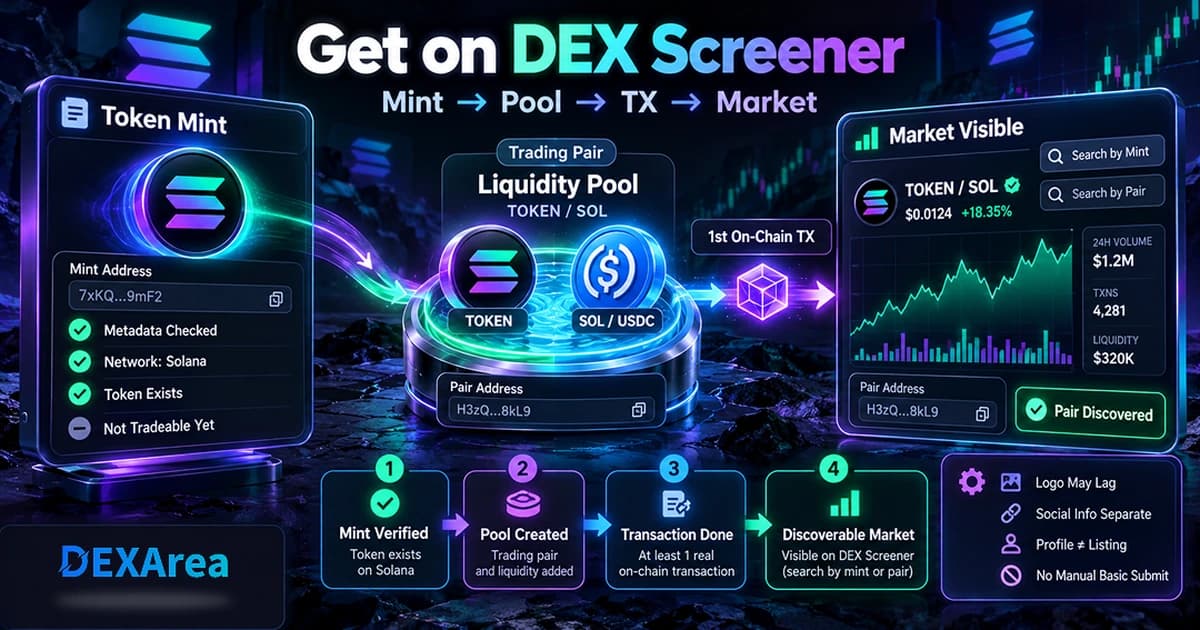
Liquidity determines how easily users can trade your token. Plan the pair (TOKEN/SOL, TOKEN/USDC), pool type, initial price ratio, liquidity size and LP token handling.
- Pool pair selected
- Pool type selected (e.g. Raydium AMM vs concentrated liquidity)
- Initial price ratio reviewed
- Liquidity amount reviewed
- LP token/position plan reviewed
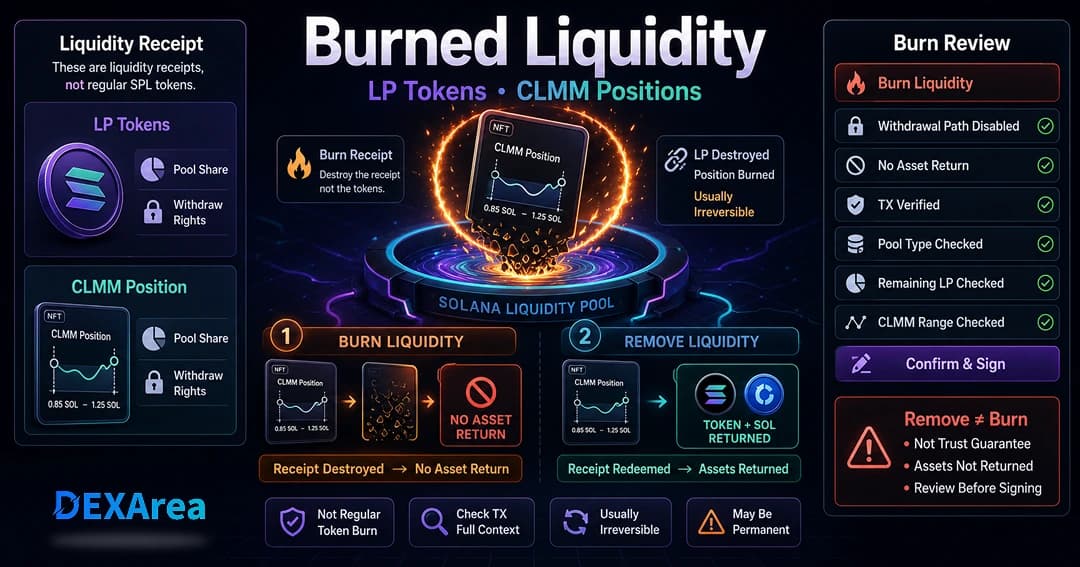
- Remove/burn liquidity consequences understood
10. Review Distribution and Airdrop Plan
Plan airdrops and multisender campaigns carefully. Wrong addresses are usually irreversible.
- Recipient list cleaned
- Test batch completed
- Token amount format reviewed
- Wallet balance sufficient
- Snapshot plan reviewed if needed
11. Prepare Public Trust Information
Transparent communication builds trust. Prepare mint address, supply, authority status, official links and revocation transaction signatures. Avoid guaranteed price claims.
Suggested items to publish:
- Token mint address (full base58 address)
- Official website and social links
- Authority status (mint/freeze active or revoked)
- Liquidity pool link
- Revoke transaction signatures
- Token supply and decimals
- Disclaimer about risks
12. Common Token Launch Security Mistakes
- Launching with wrong metadata (misspelled name, broken image URL)
- Relying on symbol instead of mint address
- Revoking mint authority too early
- Keeping mint or freeze authority active without explanation
- Making metadata immutable before fixing errors
- Creating liquidity with the wrong token or quote asset
- Burning LP tokens when the intent was to remove liquidity later
- Sending airdrops to unverified or duplicate addresses
- Not saving transaction signatures
- Not testing on Devnet
- Exaggerated safety or price claims
13. Final Pre-Launch Checklist
Use this as your launch-day ritual:
- Token mint address verified
- Token supply reviewed
- Decimals reviewed
- Metadata reviewed
- Mint authority reviewed (revoked if appropriate)
- Freeze authority reviewed (revoked if appropriate)
- Metadata/update authority reviewed (immutable if appropriate)
- Immutability decision documented
- Wallet authority ownership and backups reviewed
- Devnet tests completed where possible
- Liquidity plan reviewed (pair, amount, price)
- Distribution plan reviewed (airdrop, multisender)
- Public trust information prepared
- Transaction signatures saved
- No private keys shared; final transactions reviewed before signing
FAQ
1. What should I check before launching a Solana token?
Verify mint address, supply, decimals, metadata, authority settings, Devnet workflows, and liquidity and distribution plans.
2. Should I revoke mint authority before launch?
Usually yes for fixed supply, after minting the final supply. Do not revoke if you need future emissions.
3. Should I revoke freeze authority before launch?
Many communities expect revocation for trust; keep it only if you need compliance or recovery freezes.
4. Does revoking mint authority make my token safe?
It prevents supply inflation but does not guarantee price stability or prevent scams.
5. Does revoking freeze authority protect holders?
It removes arbitrary freeze risk but also removes your ability to freeze compromised accounts.
6. Should I make my Solana token immutable?
It can increase confidence in metadata; only do this after finalizing metadata and team consensus.
7. Can I change token metadata after launch?
Yes if update authority remains; no once it is cleared.
8. What should I check before creating liquidity?
Pair, pool type, initial price, liquidity size and LP mechanics.
9. Is burning liquidity the same as removing liquidity?
No. Removing liquidity returns underlying assets; burning LP tokens destroys them permanently.
10. Should I test my token launch on Devnet first?
Yes. It helps catch workflow mistakes without risking real funds.
11. What information should I share with my community before launch?
Mint address, supply, decimals, authority status, pool link, official channels and revocation signatures.
12. Is this checklist financial advice?
No. It provides operational best practices, not investment advice.
Launching a token is a significant milestone. By following this security checklist and using DEXArea's suite of Solana tools, you can avoid common mistakes, build trust with your community and focus on delivering real utility. Remember: no tool can guarantee success or safety, but careful preparation and transparent communication go a long way toward a smooth launch.