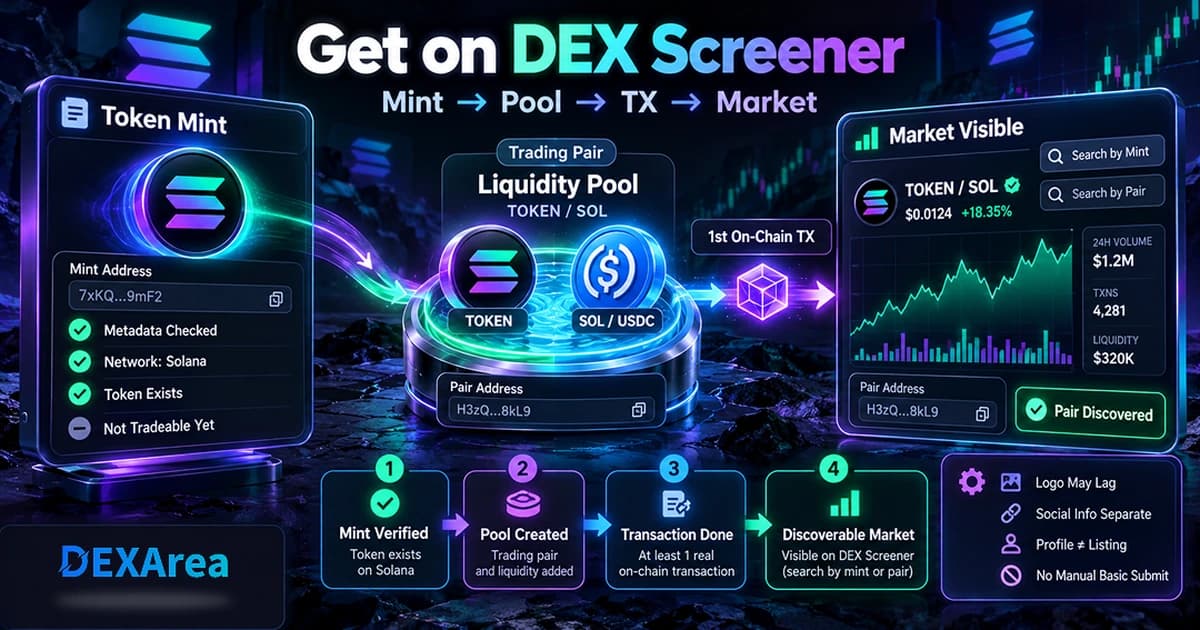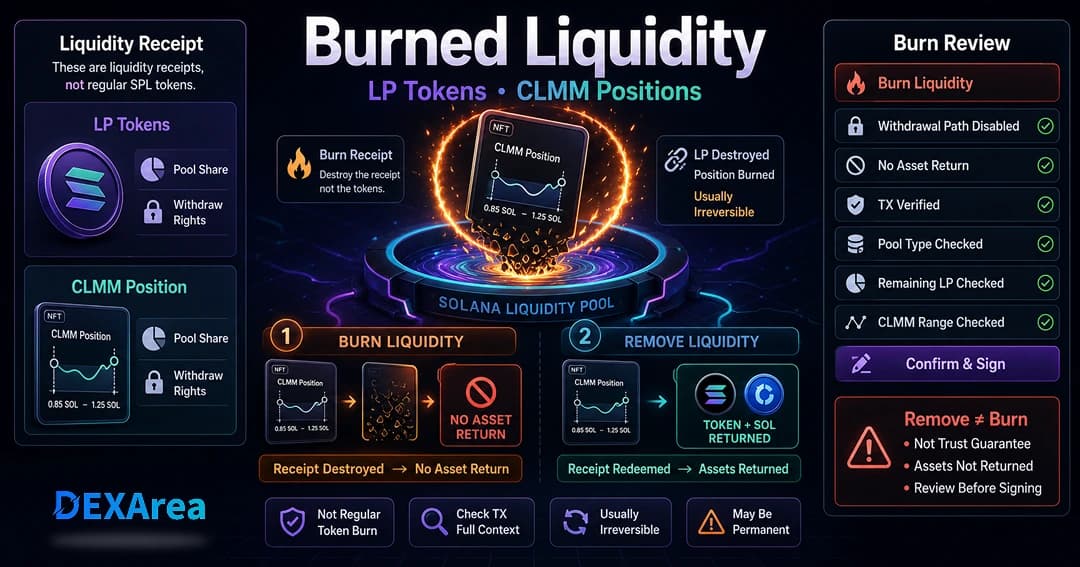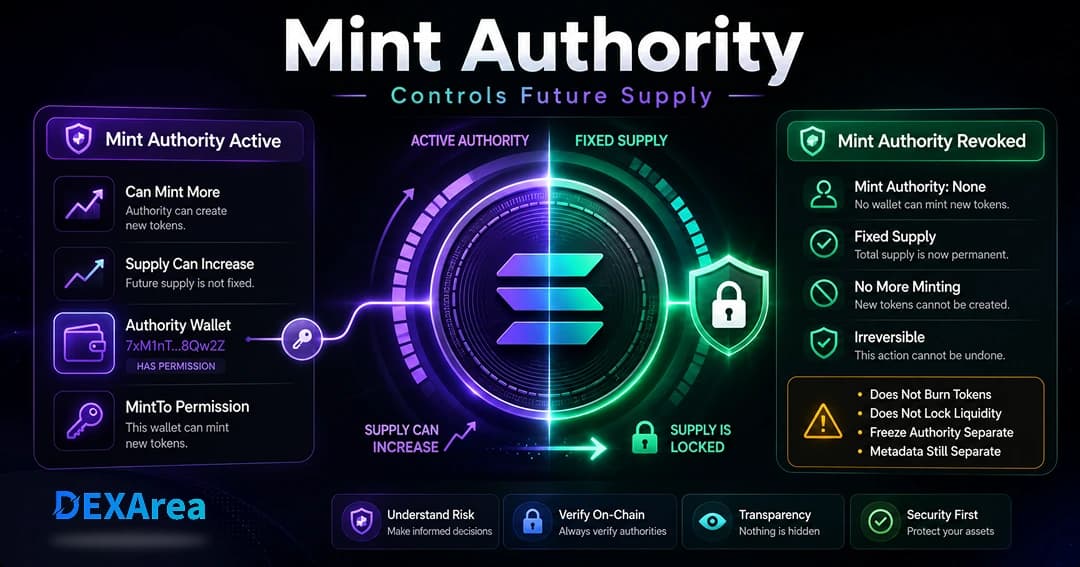
SPL Token Standard on Solana: Account Model + Token-2022 Guide
Understand SPL tokens on Solana: mint accounts, token accounts & ATAs, why SPL differs from ERC-20, and when Token-2022 extensions (fees, hooks, privacy) make sense.
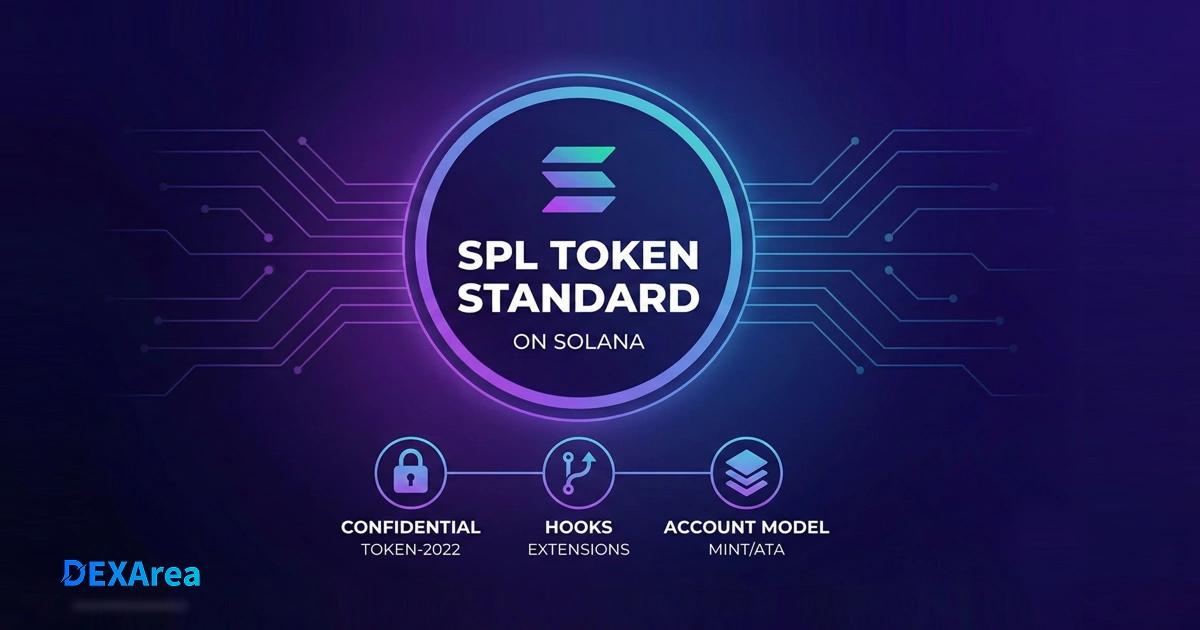
The Solana Program Library (SPL) Token Standard is the default blueprint for creating and moving digital assets on Solana. If Ethereum has "ERC-20," Solana has "SPL"—but the key difference isn't the name. It's the architecture.
On Solana, token logic is implemented in a single, canonical Token Program, while token state (like balances) lives in separate accounts. That separation is one of the reasons Solana can execute lots of non-conflicting transfers in parallel, keeping fees low and throughput high.
This guide focuses on:
- Core SPL architecture (Mint Accounts, Token Accounts, and ATAs)
- SPL vs ERC-20 (why the models behave differently under load)
- Token-2022 extensions (privacy, compliance hooks, and enterprise features)
- Security best practices for token issuers
Note (important): Some Token-2022 privacy features depend on zero-knowledge infrastructure. Availability can change over time, so always check current Solana documentation before building production flows.
TL;DR: Key Takeaways
- SPL tokens use a single canonical Token Program; balances live in separate accounts, enabling parallel execution
- Token-2022 adds modular extensions (transfer hooks, confidential transfers, fees) but most must be chosen at mint time
- SPL vs ERC-20: SPL's account-based model supports parallel transfers; ERC-20's contract-based model tends toward sequential execution
- Authority management is critical: revoke Mint Authority for fixed supply, minimize Freeze Authority unless needed
- Confidential Transfers and some Token-2022 features may have limited availability—verify network/wallet support before production
- Transfer Hooks enable compliance logic (KYC/AML, blocklists) but require careful program design
- Common pitfalls: forgetting to revoke authorities, mismatched wallet/explorer support expectations, account sizing for extensions
- Internal tooling: If you need a UI to create SPL tokens or manage authorities without writing raw transactions, DEXArea provides non-custodial tools for token creation, metadata updates, and authority management.
- Token Creator— Create SPL or Token-2022 tokens
- Update Metadata— Modify token name, symbol, or URI
- Revoke Mint Authority— Permanently revoke minting capability
- Revoke Freeze Authority— Remove ability to freeze accounts
Who This Guide Is For
- Beginners: Learn what SPL tokens are, how they differ from ERC-20, and basic account structure (Mint, Token Accounts, ATAs)
- Builders: Understand Token-2022 decision-making, extension planning, authority management, and real-world pitfalls
- Institutions & compliance teams: Evaluate Token-2022's privacy and compliance features (Confidential Transfers, Transfer Hooks) for regulated use cases
Table of Contents
- 1) The Solana Program Library (SPL): A Unified Standard
- 2) The Three Pillars of SPL Token Structure
- 3) SPL vs ERC-20: why SPL enables Solana's performance profile
- 4) Token-2022: upgrading SPL tokens into programmable assets
- 5) Confidential Transfers (CT): native privacy (with compliance options)
- 6) Transfer Hooks: compliance and custom logic on every transfer
- 7) Strategic use cases and adoption
- 7.5) Common Pitfalls and How to Avoid Them
- 8) Security and best practices for issuers
- 9) Conclusion: the SPL advantage
- Frequently Asked Questions (FAQ)
- References
About This Article
Author: DEXArea Knowledge Team
DEXArea builds non-custodial SPL and Token-2022 tooling for token creation, metadata management, authority configuration, liquidity workflows, and distribution on Solana.
Last updated: December 15, 2025
Editorial policy: This article is educational and does not constitute financial, legal, tax, or investment advice. Token-2022 features, network availability, and wallet/explorer support can change over time. Always verify current official Solana documentation and test on devnet before production deployments. Network fees, extension availability, and tooling support vary by network and may differ from what's described here.
What this article is / isn’t
- This article is: a technical, educational overview of SPL tokens, Token-2022 extensions, and common design and security considerations for builders and reviewers.
- This article isn’t: personalized financial, legal, tax, or investment advice, or a guarantee that any specific configuration is appropriate for your use case or jurisdiction.
- Time sensitivity: Details are accurate as of December 15, 2025, but Solana network conditions, program versions, and ecosystem support can change; always confirm against up-to-date official resources.
Glossary: key terms used in this guide
- Mint Account: The on-chain account that defines a token, including decimals, a total supply counter, and authorities such as Mint and Freeze.
- Token Account: An account that holds the balance of a single owner for a single mint, storing how many tokens that owner holds for that mint.
- Associated Token Account (ATA): A standard, deterministically derived token account for a given wallet + mint pair that wallets and apps treat as the default balance location.
- Program Derived Address (PDA): A program-owned address derived from seeds and a program ID, used for holding state or escrow without an associated private key.
- Cross-Program Invocation (CPI): A call from one on-chain program into another program during a single transaction, allowing composed behaviors.
- Type–Length–Value (TLV): A data layout pattern where each extension stores a type tag, length, and value, enabling extensible account layouts without breaking base fields.
- Extension: An optional feature module (for example, transfer fees or confidential transfers) that adds extra behavior and state to Token-2022 mints or accounts.
1) The Solana Program Library (SPL): A Unified Standard
SPL is a collection of on-chain programs and conventions maintained for the Solana ecosystem. For tokens, the most important idea is this:
All standard SPL tokens share the same on-chain program logic.
Instead of deploying a new token contract every time you create a new token, you create accounts (data) that are governed by a widely used, reviewed Token Program (code). That "one program, many tokens" approach improves interoperability across wallets, DEXs, explorers, payment apps, and tooling.
2) The Three Pillars of SPL Token Structure
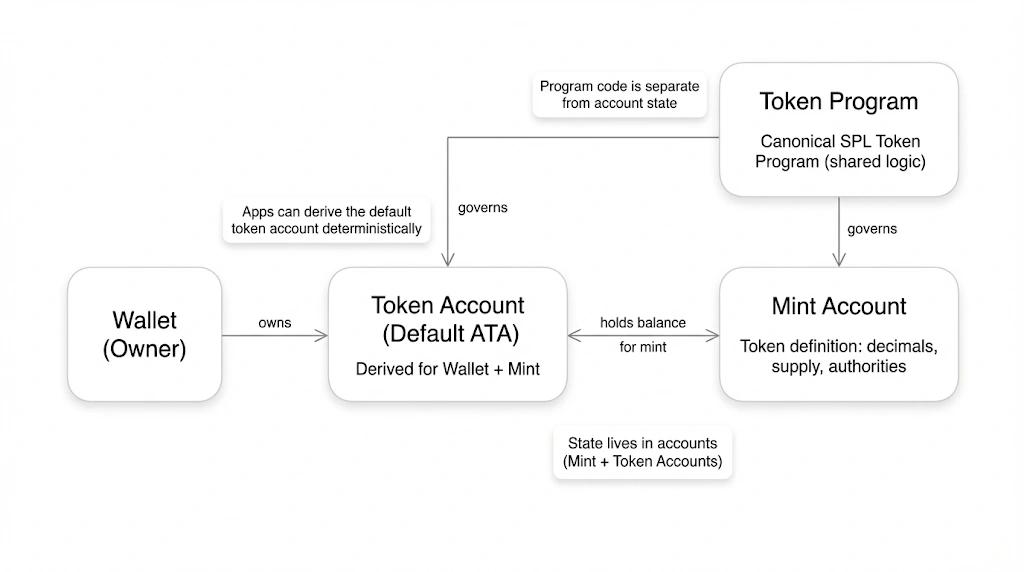
Solana uses a stateless program model: program code is separate from program state. SPL tokens follow this pattern through three main building blocks.
Mint Account (the token definition)
The Mint Account defines the token itself. It stores global configuration and control fields such as:
- Decimals (how many fractional places the token uses)
- Total supply (global supply counter)
- Mint Authority (the signer allowed to mint new tokens)
- Freeze Authority (the signer allowed to freeze specific token accounts)
Token Accounts (balances are accounts, not a mapping)
balances[address].On Solana, each user's balance for a given token lives inside a separate Token Account. So instead of "one contract storing everyone's balances," SPL uses "many small accounts," each holding the balance for:
- one owner
- one mint
This makes token balance reads and writes more explicit and helps the runtime reason about conflicts.
Associated Token Accounts (ATAs) and determinism
An Associated Token Account (ATA) is the standard "default token account" for a wallet + mint pair.
ATAs are deterministic: given a wallet address and a mint address, there is a predictable ATA address (derived via a PDA scheme). This is huge for UX:
- Apps don't have to guess which token account to use
- Wallets can "find your balance" reliably
- The ATA program can create the account automatically when needed
3) SPL vs ERC-20: why SPL enables Solana's performance profile
SPL vs ERC-20: Comparison Table
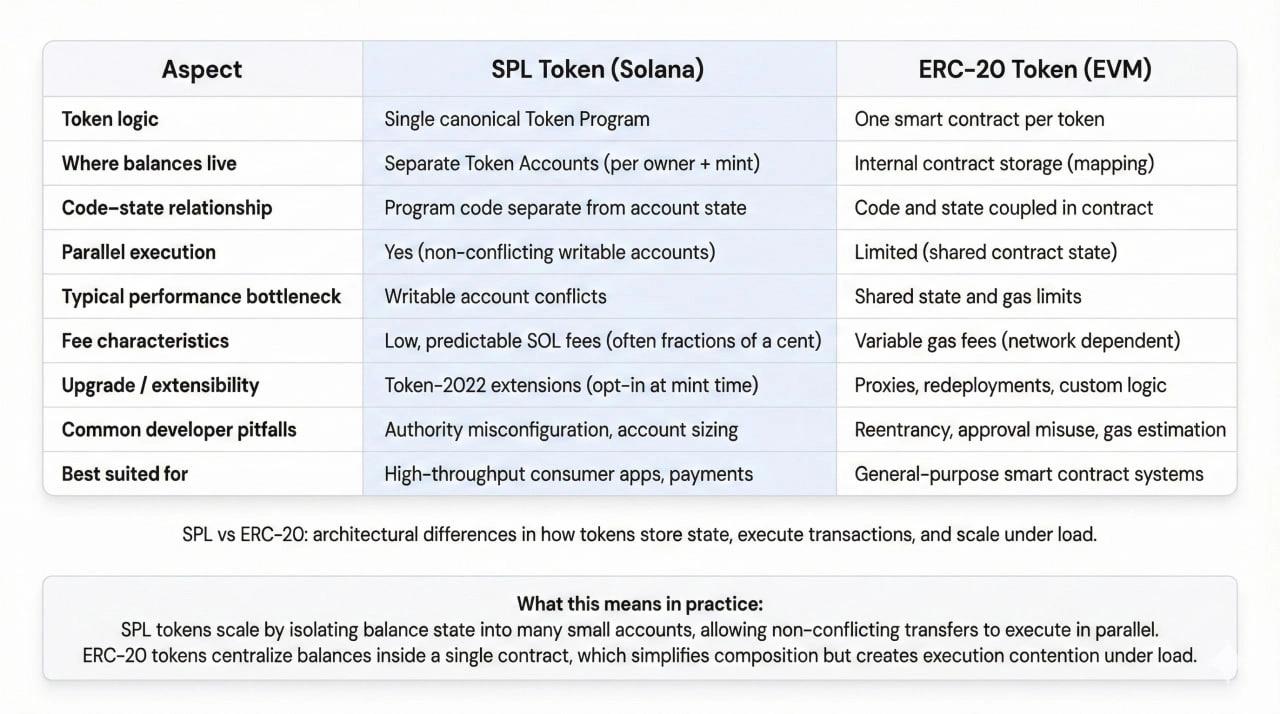
The table above summarizes how SPL and ERC-20 differ in where balances live, how programs/contracts are deployed, how parallel execution works, and how fees and failure modes typically appear in practice. On the SPL side, common issues include insufficient SOL for the rent-exempt minimum or account creation, authority and ATA configuration mistakes, and account size or extension-allocation mismatches when using Token-2022 extensions. On the ERC-20 side, developers more often contend with gas limit failures, reentrancy risks, and approval race conditions. For fees, Solana token-related transactions are typically low cost—often fractions of a cent in SOL—but still depend on network conditions, transaction size, and instruction complexity, whereas EVM gas fees are driven by gas prices and network congestion.
State management: decoupled vs coupled
- SPL: balances live in external Token Accounts
- ERC-20: balances live inside the token contract's internal state
This difference changes how execution scales.
Parallel execution (Sealevel)
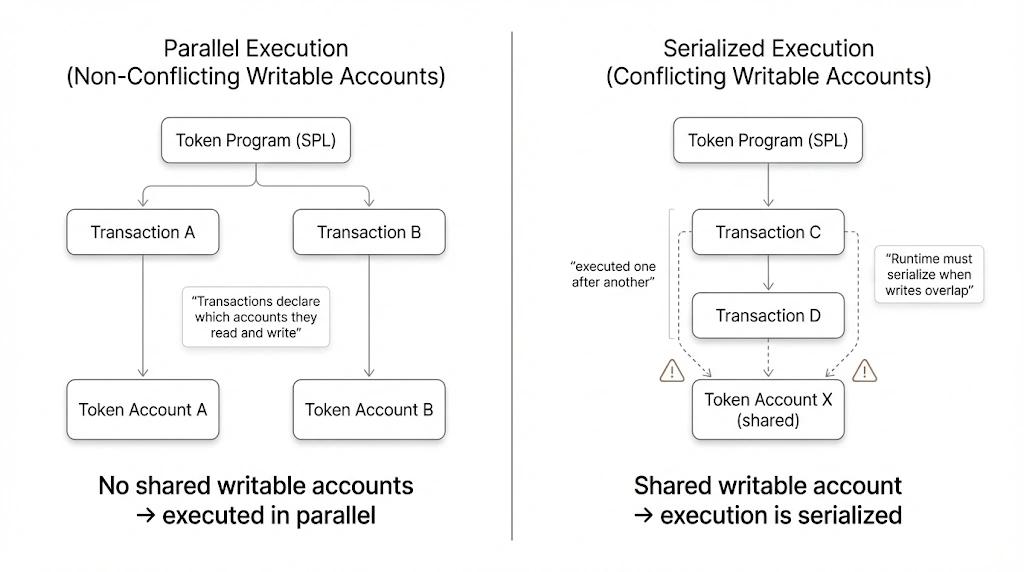
Conflicts are determined by overlapping writable accounts, not by program identity.
Solana transactions declare which accounts they read/write. Because SPL token balances are stored in separate accounts, many transfers touch different Token Accounts and don't conflict.
The runtime can then execute those non-conflicting transactions in parallel (often described as Solana's "Sealevel" parallel execution model). Ethereum-style execution is more commonly constrained into sequential behavior when lots of calls compete for shared state.
Transaction integrity and cost
Two practical outcomes matter to builders:
- Atomicity: multiple instructions can be bundled so they all succeed or the whole transaction fails (useful for swaps, multi-step transfers, and complex flows).
- Low fees (with variability): token operations are typically inexpensive (often fractions of a cent in SOL), but actual fees depend on network conditions, transaction size, and instruction complexity; this still enables many high-frequency use cases such as in‑game currencies or micro‑payments.
4) Token-2022: upgrading SPL tokens into programmable assets
Token-2022 (often called Token Extensions) is the next-generation token program on Solana. It's designed to keep broad compatibility while adding modular extensions that can be enabled at mint/account creation time.
The technical headline: Token-2022 can store extra extension state using a Type–Length–Value (TLV) pattern, making the token account layout extensible without breaking the base fields.
Token-2022 extensions can add capabilities like:
- transfer fees
- metadata patterns
- interest-bearing behavior
- compliance and permissioning features
- privacy-preserving transfers
One important design constraint: most extensions must be chosen up front. You can't always "add it later" without reallocating or redesigning accounts—so plan your token's feature set early.
When to Use Token-2022 vs Classic Token Program
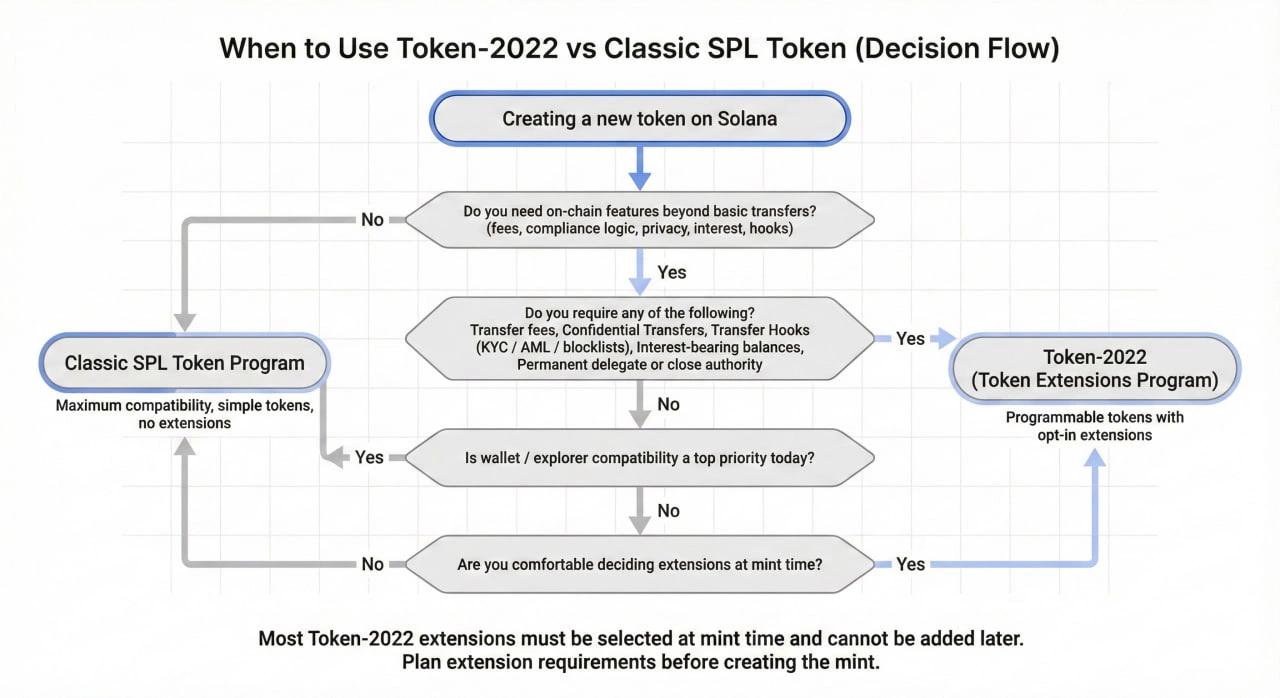
The decision flow above illustrates when it is practical to use Token-2022 extensions instead of the classic Token Program—for example, when you require on-chain fee logic, privacy, or compliance hooks versus when broad compatibility and simplicity are more important.
Use Token-2022 if you need:
- ✅ Transfer Hooks for compliance (KYC/AML, blocklists, RWA rules)
- ✅ Confidential Transfers for privacy (with optional auditor oversight)
- ✅ Transfer fees that accrue to a designated account — after launch you can update Token-2022 transfer-fee configuration separately from claiming withheld Token-2022 transfer fees
- ✅ Interest-bearing tokens (e.g., staking rewards built into the token)
- ✅ Metadata extensions beyond basic on-chain name/symbol
- ✅ Permanent delegate (irrevocable transfer authority for specific use cases)
- ✅ Close authority (ability to close empty token accounts and recover rent)
Use Classic Token Program if:
- ✅ You need maximum wallet/explorer compatibility (Token-2022 support varies)
- ✅ You don't need any extensions
- ✅ You're building for broad consumer adoption where compatibility > features
- ✅ You're unsure about extension requirements (classic tokens are simpler)
Migration constraint: You cannot migrate an existing classic SPL token to Token-2022. If you need Token-2022 features, you must create a new Token-2022 mint and migrate holders (or use a bridge/wrapper pattern).
Practical mini-example: detecting Token-2022 vs Classic SPL
When building apps, you often need to know if a token uses the Classic Token Program or Token-2022. They are different on-chain programs with different IDs.
@solana/web3.js:import { Connection, PublicKey } from '@solana/web3.js';
import { TOKEN_PROGRAM_ID, TOKEN_2022_PROGRAM_ID } from '@solana/spl-token';
async function checkTokenProgram(connection: Connection, mintAddress: PublicKey) {
const mintInfo = await connection.getAccountInfo(mintAddress);
if (!mintInfo) throw new Error('Mint account not found');
if (mintInfo.owner.equals(TOKEN_PROGRAM_ID)) {
console.log('Classic SPL Token');
} else if (mintInfo.owner.equals(TOKEN_2022_PROGRAM_ID)) {
console.log('Token-2022 (Extensions enabled)');
} else {
console.log('Unknown program or not a token mint');
}
}
Why this matters:
- Wallets & Integrations: Some older wallets only listen for Classic Token Program events. If you send Token-2022 tokens to a wallet that doesn't support them, they might not appear in the UI (though the funds are safe on-chain).
- ATA Creation: You must use the correct program ID when creating Associated Token Accounts. Using the wrong ID will derive the wrong address.
Caution: This code is for educational purposes. Always test on devnet and verify current library versions before building production flows.
5) Confidential Transfers (CT): native privacy (with compliance options)
The Confidential Transfer extension enables transferring tokens without revealing amounts or balances publicly. The token account addresses remain public, but the numeric values can be obscured.
Current availability note (don't skip)
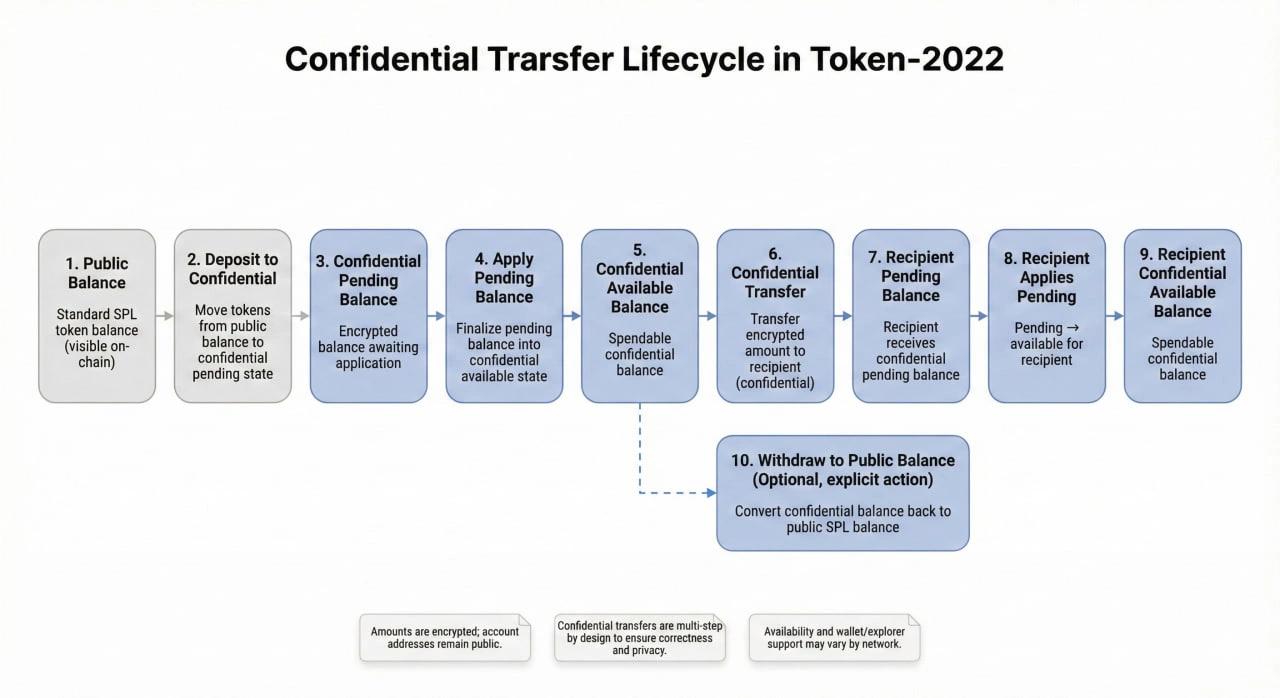
As of December 2025: Solana's confidential transfer stack can be temporarily disabled on some networks while components undergo audits. Availability varies by network (mainnet-beta, devnet) and wallet support is not universal. Treat confidential transfers as an "advanced feature" that requires:
- Checking current network readiness before committing to production
- Verifying wallet support (Phantom, Solflare, etc.)
- Testing on devnet first
- Having fallback plans if CT is unavailable
Cryptographic mechanisms (conceptual)
Confidential transfers rely on modern cryptography so the network can verify correctness without learning amounts. You'll commonly see these concepts mentioned:
- Homomorphic encryption: allows arithmetic on encrypted values
- Zero-knowledge proofs (ZKPs): prove statements about values without revealing them
The confidential transfer flow (developer-focused)
A typical flow isn't just "transfer()" once. It's staged:
- Deposit: public balance → confidential pending balance
- Apply pending: pending → confidential available balance
- Transfer: confidential transfer between accounts
- Recipient applies pending again
- Withdraw (optional): confidential available → public balance
That pending/available model is not a cosmetic detail—it's part of how the system stays safe under adversarial conditions (e.g., sequencing and front-running considerations).
Optional auditor oversight
For regulated environments, a mint can optionally be configured so a designated auditor key can decrypt balances for compliance/reporting—balancing privacy for the public with visibility for authorized oversight.
6) Transfer Hooks: compliance and custom logic on every transfer
The Transfer Hook extension lets a token enforce custom logic on every transfer by calling another program during transfer execution.
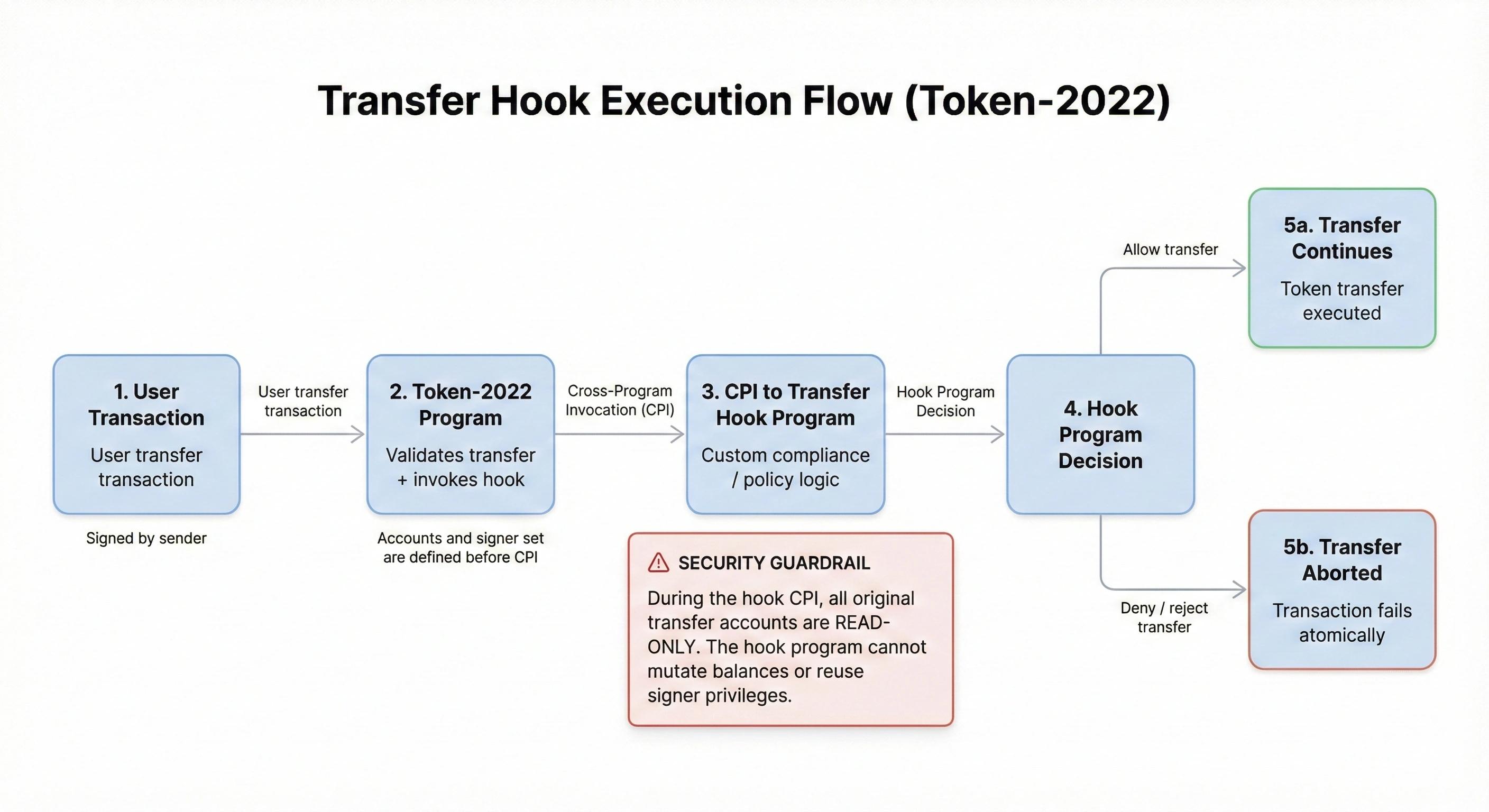
That's a big deal for:
- KYC/AML allowlists and blocklists
- RWA tokenization rules
- royalties or fee logic
- policy checks that must run before value moves
Implementation reality: Transfer Hooks require deploying a separate program that implements the hook interface. As of December 2025, wallet and explorer support for Transfer Hooks varies. Some wallets may not display transfer hook status clearly, and explorers may not show hook program interactions in transaction views. Test thoroughly with your target wallets and tools before production.
Safety design: read-only accounts during the hook CPI
Solana's transfer-hook design includes an important guardrail: when the token program CPIs into the hook program, the accounts from the original transfer are converted to read-only. The sender's signing authority does not "leak" into the hook program.
This reduces the risk of a malicious hook program doing unexpected things with the sender's privileges.
7) Strategic use cases and adoption
SPL is the default asset layer for most Solana activity:
- DeFi & payments: DEXs, aggregators, payment rails, and wallets revolve around SPL tokens.
- High-volume consumer apps: cheap, fast transfers enable loyalty points, in-game economies, and microtransactions.
- Institutional finance & RWA: Token-2022's privacy and compliance hooks make it a more realistic substrate for regulated assets—where transfer rules and reporting are features, not bugs.
7.5) Common Pitfalls and How to Avoid Them
Real-world mistakes builders make when working with SPL tokens:
- Forgetting to revoke Mint Authority: If you want fixed supply, revoke Mint Authority immediately after initial minting. Leaving it active risks accidental or malicious supply inflation.
- Freeze Authority confusion: Freeze Authority can freeze individual token accounts, not the entire mint. If you don't need this power, revoke it to reduce trust assumptions.
- Wallet/explorer compatibility expectations: Not all wallets and block explorers fully support Token-2022 extensions. Test with Phantom, Solflare, and popular explorers before assuming universal compatibility.
- Metadata mismatch expectations: Token metadata (name, symbol, URI) can be updated, but DEX pool labels, wallet displays, and explorer listings may cache or derive labels differently. Updating metadata doesn't automatically rename Raydium/Jupiter pool pairs—the pool identity is tied to mint addresses, not metadata. See the FAQ on pool naming for details. If you're planning to create a liquidity pool, finalize your metadata first.
- Account sizing for extensions: Token-2022 extensions require additional account space. If you enable multiple extensions, ensure you account for rent-exempt minimums and extension data sizes. Underestimating can cause creation failures.
- ATA derivation errors: Always use the official Associated Token Account program for ATA derivation. Manual derivation mistakes can lead to funds sent to unrecoverable addresses.
- Transfer Hook program security: If using Transfer Hooks, audit your hook program carefully. While the token program converts accounts to read-only during hook CPI, the hook logic itself must be secure and compute-efficient.
- Confidential Transfer availability assumptions: As of December 2025, Confidential Transfers may be temporarily disabled on some networks during audits. Always check current network status and wallet support before building production flows that depend on CT.
- Authority multisig complexity: Using multisig for Mint/Freeze Authority adds operational complexity. Test multisig flows thoroughly and document key rotation procedures.
- Extension planning: Most Token-2022 extensions cannot be added after mint creation. Plan your extension set early, or accept that you may need to create a new mint and migrate holders.
After launch, manage authorities using dedicated authority tools.
8) Security and best practices for issuers
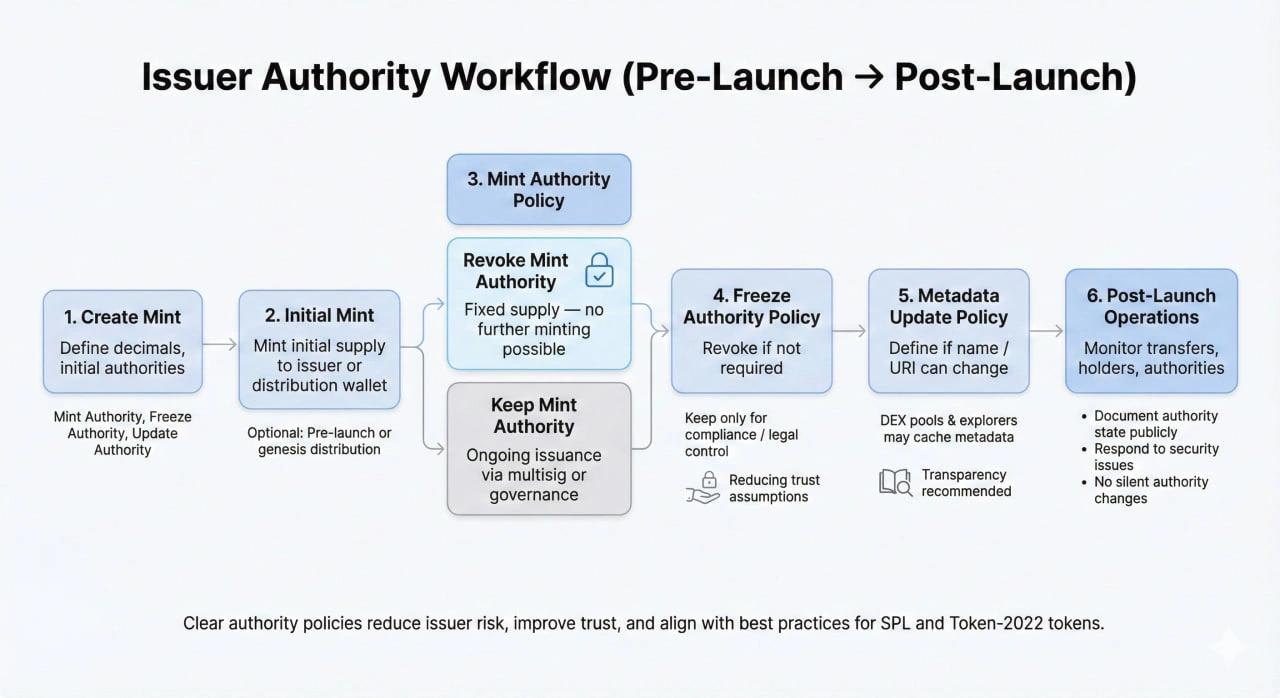
Token design is not just "set name and symbol." The most common issuer mistakes are authority mistakes.
Pre-launch security checklist
Before launching your token:
- Decide on supply model: Fixed supply (revoke Mint Authority) or ongoing minting (secure Mint Authority with multisig/governance)
- Plan authority structure: Who controls Mint Authority? Freeze Authority? Document and communicate this publicly
- Choose Token Program: Classic Token Program or Token-2022? If Token-2022, which extensions do you need? (Remember: most extensions must be chosen at mint time)
- Test extension compatibility: If using Token-2022, verify wallet/explorer support for your chosen extensions
- Set up multisig/governance: If keeping authorities, use multisig or governance (e.g., Realms) rather than single-key control
- Document authority policy: Publicly state what authorities exist, who controls them, and under what conditions they can be used
- Test on devnet: Create test tokens, revoke authorities, test transfers, verify metadata displays correctly
- Verify metadata accuracy: Name, symbol, URI should be accurate and point to persistent resources (IPFS, Arweave, or reliable HTTPS)
Post-launch security checklist
After launching:
- Revoke Mint Authority (if fixed supply): Do this immediately after initial minting, not "later"
- Revoke or secure Freeze Authority: If you don't need it, revoke it. If you do, use multisig
- Monitor token accounts: Watch for unusual activity, large transfers, or potential security issues
- Keep metadata updated (if needed): Update metadata URI if information changes, but understand that DEX pools and explorers may cache labels
- Document any changes: If you update metadata or make authority changes, document them publicly
- Respond to security concerns: If holders report issues, investigate promptly and communicate transparently
- Revoke Mint Authority— Permanently revoke minting capability
- Revoke Freeze Authority— Remove ability to freeze accounts
- Make Immutable— Make token metadata permanent
- Transfer Authority— Transfer token authority to another wallet
Authority management principles
- Revoke Mint Authority if you want fixed supply (do this immediately, not "later")
- Minimize or revoke Freeze Authority unless you truly need it (e.g., for compliance/legal holds)
- Use multisig or well-structured governance for any authority you must keep
- Document your policy publicly: What can you change? What can't you change? Who controls authorities?
- Test authority revocation: Before mainnet, test that revocation works and that you can't accidentally mint more
- Consider making your token immutable to permanently lock metadata
Token-2022 audits and institutional trust
Token-2022 continues to evolve and has undergone security review as it has matured. When evaluating Token-2022 for production, review any available audit reports from official Solana ecosystem sources, test on devnet, and verify current network and wallet support for the specific extensions you plan to rely on.
9) Conclusion: the SPL advantage
The SPL token standard isn't just "Solana's ERC-20." It's an architecture choice:
- Performance & cost come from Solana's account model and parallel execution.
- Programmability with guardrails comes from Token-2022 extensions like Confidential Transfers and Transfer Hooks.
If you're building on Solana, understanding SPL at the account level (Mint, Token Accounts, ATAs) isn't optional—it's the foundation that makes everything else predictable, scalable, and composable.
Frequently Asked Questions (FAQ)
References
Official Solana & SPL docs
- Solana Program Library (SPL)
- SPL Token Program docs
- Token-2022 (Token Extensions) docs
- Token Extensions overview
- Associated Token Account (ATA) program
- Solana accounts model
- Sealevel parallel processing
- Program Derived Addresses (PDAs)
Token-2022 extension pages
Source code
Interfaces
Note: Network status, wallet support, and extension availability can change. Always verify current documentation and test on devnet before production deployments.