Raydium AMM vs CPMM vs CLMM: Which Pool Type Should You Choose?
Compare Raydium AMM v4, CPMM, and CLMM pool types on Solana: liquidity style, LP tokens vs NFTs, Token-2022 support, use cases, and how to choose before creating a pool with DEXArea.
Raydium AMM vs CPMM vs CLMM: Which Pool Type Should You Choose?
Raydium isn’t a single liquidity model—it offers multiple pool types, and the choice you make influences how your Solana token trades. Automated market maker (AMM) pools, constant-product market maker (CPMM) pools, and concentrated-liquidity market maker (CLMM) pools all handle liquidity differently. The right model depends on your launch goals, initial liquidity size, expected volatility, how actively you plan to manage the pool, and your experience with liquidity ranges.
TL;DR
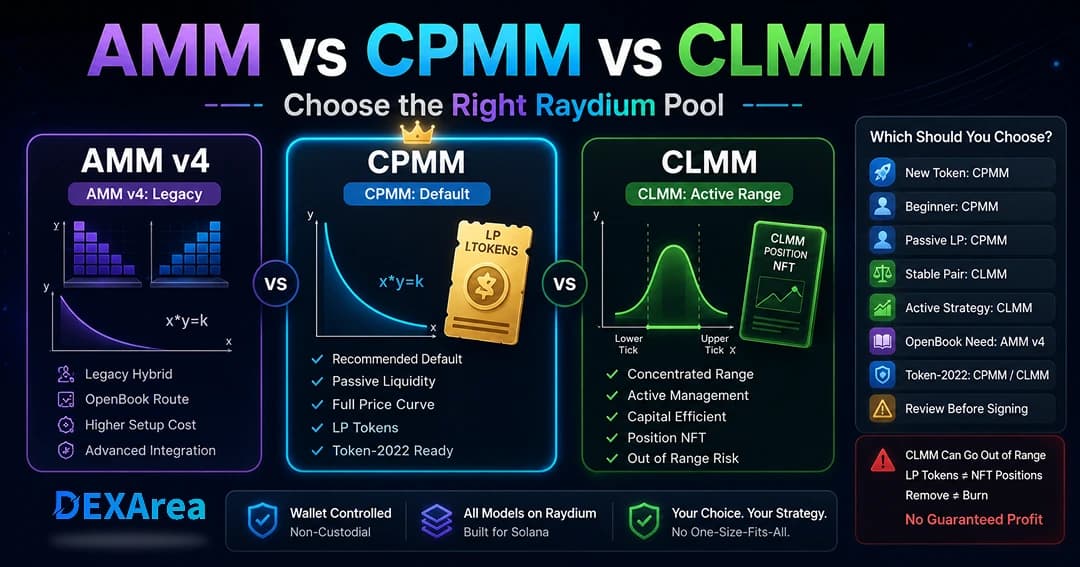
- Multiple models — Raydium supports AMM v4, CPMM, and CLMM. Each differs in liquidity distribution, pricing, and management overhead.
- CPMM is the default — Raydium recommends CPMM for most new permissionless pools: cheaper than legacy AMM v4, supports Token-2022, and is easier to operate.
- CLMM is capital-efficient but active — Liquidity sits in a price range; inside the range each dollar is more productive, outside the range it earns nothing.
- AMM v4 is legacy — Still operational but less common for new launches due to higher setup cost and OpenBook dependency.
- No universal winner — Choose CPMM for simplicity and broad liquidity; choose CLMM when you understand ranges and can rebalance.
What Are Raydium Pool Types?
The pool type defines how liquidity sits on the price curve and how swaps are priced. It affects slippage, fees, capital efficiency, and how you manage your position. When you create a pool through DEXArea, you choose among AMM v4, CPMM (standard constant-product), and CLMM (concentrated liquidity).
| Aspect | Constant-product (AMM v4 / CPMM) | CLMM |
|---|---|---|
| Price curve | Liquidity across all prices (x·y ≥ k) | Liquidity only in a selected range |
| Receipt | Fungible LP token | Position NFT |
| Management | Mostly passive | Often requires range adjustments |
Quick Comparison: AMM vs CPMM vs CLMM
| Pool type | Best for | Complexity | Liquidity style | Main trade-off |
|---|---|---|---|---|
| AMM v4 | Legacy hybrid pools with OpenBook integration | Medium | Spread across all prices | Familiar but costly; OpenBook dependency |
| CPMM | Standard launches, meme/community tokens, passive LPs | Low | Full-spectrum constant-product curve | Simple and cheaper to create; less capital-efficient than CLMM |
| CLMM | Stable/correlated pairs, advanced LP strategies | Medium–High | Concentrated in a chosen range | Higher efficiency in-range; out-of-range earns nothing |
What Is a Raydium AMM Pool?
Raydium’s original AMM v4 pools are hybrid pools that integrate with the OpenBook order book. Like CPMM, they follow the constant-product formula x·y ≥ k. AMM v4 routes part of liquidity through OpenBook for mid-price depth, which increases setup cost and requires an external market ID.
What Is a Raydium CPMM Pool?
A CPMM pool holds two reserves and enforces x·y ≥ k after every swap. Marginal price is y/x; slippage grows with trade size. Liquidity providers receive a fungible LP token representing their share.
Raydium positions CPMM as the right product for most new pools: cheaper than AMM v4, Token-2022 support, and no OpenBook market required. The UI typically suggests “Standard AMM (CPMM)” and warns that CLMM needs range management.
CPMM suits:
- Community or meme launches with unpredictable price discovery
- Volatile new tokens where full-curve liquidity avoids going out of range
- Passive LPs who don’t want to rebalance
- Teams that want a fungible LP token for staking or integrations
What Is a Raydium CLMM Pool?
How CLMM works
- You set tick bounds; liquidity is active only between them.
- Multiple fee tiers map to tick spacing and trade fees.
- Fees and rewards accrue per position, not via a single fungible LP token.
- Token-2022 is supported with similar restrictions as CPMM.
What CLMM is not
- Not set-and-forget—if price leaves your range, fees stop until you rebalance.
- Not free to open—initializing tick arrays costs rent.
- Not a drop-in replacement for CPMM—even a wide CLMM range uses NFT positions and behaves differently.
When to choose CLMM
Choose CLMM when you:
- LP stable or mean-reverting pairs (e.g. USDC/USDT, liquid-staking pairs)
- Can monitor price and rebalance
- Want per-pool incentives without a separate farm
- Need per-position accounting for advanced products
Prefer CPMM for unknown price discovery, fungible LP tokens, or passive LP experience. Prefer AMM v4 only when you specifically need hybrid OpenBook depth.
CPMM vs CLMM: The Practical Difference
CPMM characteristics
- Liquidity across the full price spectrum (x·y ≥ k)
- No “out of range” concept—deposit once until you withdraw
- Less capital-efficient at the mid-price
- Fungible LP token—easy to stake or compose
- Recommended default for most new pools
CLMM characteristics
- Liquidity only inside your band; highly efficient in-range
- Active management when price drifts
- NFT positions—transfer NFT = transfer position
- Per-position fee accounting and optional built-in reward streams
For a volatile community token, CPMM is usually easier. For stable/correlated pairs with active management, CLMM can earn more per dollar of liquidity. Neither guarantees profitability; both face impermanent loss and market risk.
Which Pool Type Is Best for a New Solana Token?
For most new tokens—especially community or meme projects—CPMM or simple AMM-style pools are easier. They need no range management, spread liquidity across the curve, and mint fungible LP tokens. Teams new to liquidity should avoid narrow CLMM ranges; going out of range makes liquidity inactive.
CLMM is more advanced and works best when you can estimate a price band or pair against a stable/correlated asset. A very wide CLMM range mimics CPMM poorly and may cost more in tick-array rent. A complex pool type doesn’t make a token more professional—pick what you can manage.
Choosing a Pool Type by Use Case
| Use case | Likely better fit | Why |
|---|---|---|
| Meme/community launch | CPMM or simple AMM | Broad liquidity; no range management |
| Stablecoin-style pair | CLMM | Concentrated bands near parity |
| Highly volatile new token | CPMM | Liquidity always on the curve |
| Experienced LP strategy | CLMM | Precise placement and fee tiers |
| Beginner token creator | CPMM or AMM | Lower complexity; fungible LP |
| Passive liquidity | CPMM | Set and forget |
| Active range management | CLMM | Higher efficiency; requires monitoring |
Pool Type and Initial Liquidity
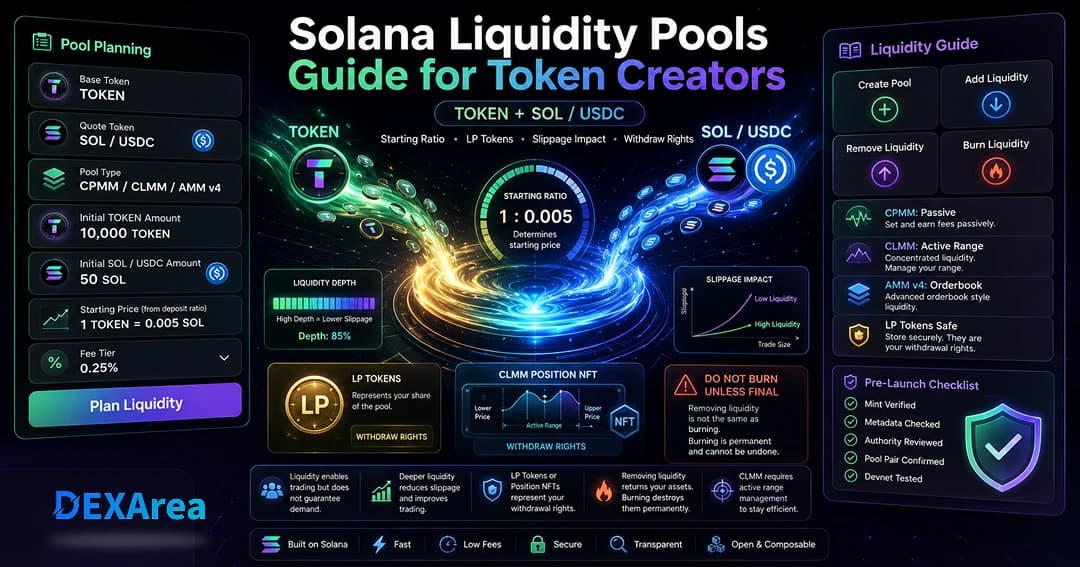
For CLMM you must also pick a range: narrow bands concentrate liquidity but go out of range faster; wide bands cost more rent and reduce efficiency. Review token amounts, initial price, and range before signing.
Pool Type and LP Tokens / Positions
CPMM / AMM v4 — Fungible LP tokens represent pool share. Add/remove by minting or burning LP tokens; many farms expect fungible LP.
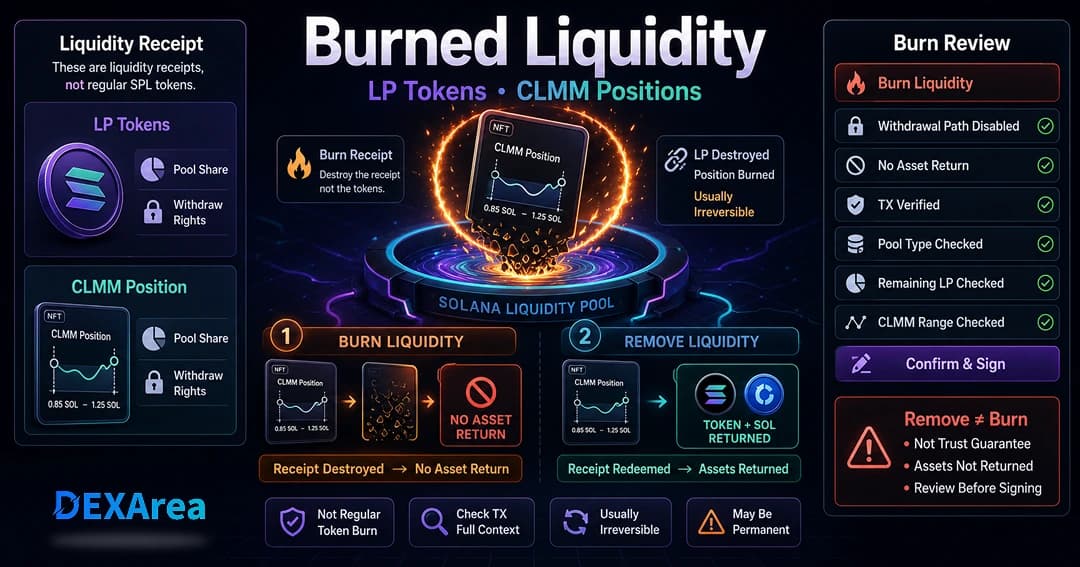
CLMM — Each position is an NFT storing ticks, liquidity, and fee growth. Transfer the NFT to transfer the position. Removing liquidity decreases liquidity on the NFT; burning destroys the position. Confirm integrations accept CLMM NFTs before relying on farms.
Pool Type and Token-2022 Considerations
| Pool type | Token-2022 support |
|---|---|
| CPMM | Full support including transfer-fee mints |
| CLMM | Supported via SwapV2-style accounts |
| AMM v4 | Does not support Token-2022 |
Common Mistakes When Choosing a Raydium Pool Type
- Choosing CLMM only because it sounds advanced
- Setting too narrow a range on a volatile token
- Assuming CLMM always beats CPMM
- Ignoring Token-2022 transfer fees or unsupported AMM v4
- Wrong mint or quote asset
- Unintended initial deposit ratio
- Confusing fungible LP tokens with CLMM NFTs
- Confusing remove vs burn liquidity
- Not reviewing the wallet transaction preview
Decision Checklist: Which Pool Type Should You Choose?
- Correct token mint and quote asset verified
- Token volatility considered (volatile → CPMM; stable → maybe CLMM)
- Launch goal clear (community, stable pair, advanced strategy)
- Initial liquidity and price planned
- Pool complexity understood (CPMM simpler than CLMM)
- Active vs passive management decided
- CLMM out-of-range risk understood
- LP token vs NFT behaviour understood
- Exit/adjustment plan (remove vs burn)
- Token-2022 compatibility checked
- Transaction details reviewed before signing
Step-by-Step: Choosing Before You Create
- Define your launch goal (public launch, stable pair, treasury LP, etc.).
- Choose quote asset (SOL, USDC, or ecosystem token).
- Estimate volatility and whether you can keep a CLMM range in band.
- Decide how actively you will manage liquidity.
- Review LP token vs NFT consequences for your roadmap.
- Create via DEXArea Create Pool—select type, fee tier, initial price, and seed liquidity.
What to Do After Creating the Pool
- Save pool address and transaction signature.
- Verify mints and fee tier on-chain.
- Test a small swap before announcing.
- Monitor slippage and depth; add liquidity if needed.
- Remove or burn liquidity only when you understand the outcome.
- Snapshot token holders if planning rewards.
- Keep monitoring price, volume, and range status (CLMM).
FAQ
What is the difference between Raydium AMM, CPMM, and CLMM?
AMM v4 is the legacy OpenBook-integrated hybrid. CPMM is constant-product across the full curve. CLMM concentrates liquidity in a chosen range.
Is CLMM better than CPMM?
Neither is universal. CLMM can be more efficient in-range but needs management. CPMM is simpler and Raydium’s default for new pools.
Which pool type is best for a new token?
Usually CPMM or simple AMM-style pools for unknown price discovery. CLMM fits stable pairs or advanced strategies.
What is concentrated liquidity?
Supplying liquidity only between chosen price ticks; productive in-range, inactive out-of-range.
What happens if CLMM goes out of range?
The position stops earning swap fees until you rebalance or widen the range.
Is CPMM easier for beginners?
Yes—no range management and a fungible LP token.
Which type for TOKEN/SOL launches?
Most volatile TOKEN/SOL launches use CPMM first.
Which type for stable pairs?
CLMM often works well near the peg (e.g. USDC/USDT).
Can I remove liquidity from all types?
Yes—burn fungible LP for CPMM/AMM v4; decrease liquidity on CLMM NFT positions via DEXArea flows.
Should I burn liquidity after creating a pool?
Only if you intend to lock permanently; otherwise remove normally so you can withdraw later.
Does pool type guarantee price stability?
No—it affects liquidity distribution, not market valuation.
Is this financial advice?
No. Educational content only.
Conclusion
Raydium lets Solana creators choose constant-product or concentrated-liquidity models. CPMM is simple, supports modern token standards, and spreads liquidity across all prices. CLMM offers higher in-range efficiency but demands range management. AMM v4 remains for OpenBook-centric setups with higher setup cost.
Disclaimer
This guide is for educational purposes only and is not financial advice. Pool choice affects trading experience, capital exposure, and operational complexity. Always review transactions in your wallet before signing; test on Devnet when possible.
DEXArea is non-custodial. Your wallet signs transactions, and your private keys stay in your wallet.